Research on revolving stages
The roots of revolving stages can be traced to Japan. Japanese original stages were created through a fusion of performing arts, carpentry technology and skills.
Progression of revolving stage mechanisms in the Edo Era
Revolving stages began with double stages, in which case a movable stage was installed on top of a normal flat stage. Initially, these stages were capable only of forward-reverse and left-right linear movement, but later on rotational movement also became possible.
Next came the development of the "cutout" type revolving stage, in which case a circular section of the flat stage was cut out and made to rotate on the same plane as the flat stage.
Thereafter, attention was given to improving the smoothness of rotation of cutout type revolving stages, and efforts were made to improve rotating mechanisms. Cutout type revolving stages were divided into two types based on the relationship between the stage and its supporting central shaft: "spinning-top" stages and "spinning-dish" stages.
Revolving stages began with double stages, in which case a movable stage was installed on top of a normal flat stage. Initially, these stages were capable only of forward-reverse and left-right linear movement, but later on rotational movement also became possible.
Next came the development of the "cutout" type revolving stage, in which case a circular section of the flat stage was cut out and made to rotate on the same plane as the flat stage.
Thereafter, attention was given to improving the smoothness of rotation of cutout type revolving stages, and efforts were made to improve rotating mechanisms. Cutout type revolving stages were divided into two types based on the relationship between the stage and its supporting central shaft: "spinning-top" stages and "spinning-dish" stages.
- Spinning-top stages: The revolving floor and shaft were connected, and the floor was rotated by means of rotating the shaft. The revolving floor and its rotating elements rested on an ukedai track located under the floor perimeter.
- Spinning-dish stages: The revolving floor rotated on the top of a stationary central shaft, which was planted securely in the ground. Rolling elements such as balls or rollers were attached to a retainer and enabled smooth rotational movement. This construction is similar to that of a modern slewing rim bearing.
Here is a diagram and some photos of the revolve in the Konpira Theatre which was constructed in 1835. This revolving stage is the cutout, spinning-dish type and has a cage & roller apparatus. It must have taken so much work to build this revolve using only hand tools.
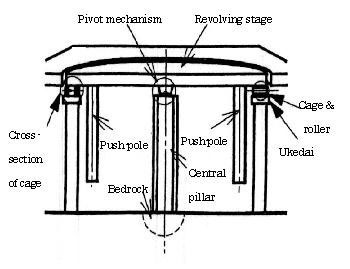 |
| Outline of the Konpira Theater revolving stage. |
 |
| Cage & roller set of the Konpira Theater revolving stage. |
 |
| This is a photo from underneath the stage at the Konpira Theatre. The stage was made to revolve with manpower using push poles located around the central pillar. Photographer: Christian Kaden |
 |
This is a photo of the stage at the Konpira Theatre.
If you look closely you can see the cutout of the revolving stage.
Photographer: Christian Kaden.
|

No comments:
Post a Comment