Monday, 6 January 2014
Orchestre pit steps
Since making the long set of steps for panto I have had the opportunities to make more steps. Learning from the mistakes I made the first time around I feel confident cutting out formers treads and risers. I have atteched some photos of a set of steps I made for the orchestre pit in the new athenaeum theatre. I had great pleasure making these steps as I knew what to do from start to finish.


Saturday, 7 December 2013
Research Project: Drum Revolve
The Drum Revolve used in the Olivier Theatre, National Theatre, London.
Specifications:
- 5 stories deep, into car park
- Is made on a standard revolve, but with elevators inside
- Sets can be built on top of the elevators
- Within a minute: sets can then be sunk into the stage, revolved, then lift another bare set of the stage
Watch the National Theatre's drum revolve here
Watch the National Theatre's drum revolve in action here
Friday, 6 December 2013
Research Project: Interview
Interview with Jason Daily, Workshop Manger at the Lyceum Theatre in Edinburgh.
I asked Jason the difference between the revolving stages the lyceum have used in the past and the stages that they now hire from the Revolving Stage Company.
Past revolving stages:
I was told that in the past the wheels that were used on the revolves would roll along the floor but apparently this was quite loud and if there was a problem with any of the wheels the whole revolve would have to be taken up to try and fix the problem.
 |
| An example of how the wheels of the past revolves would roll along the floor. |
Jason told me that he would never go back to the old way of revolving a set on stage. He went on to explain how with the revolves that they now hire, have wheels upside down and a motor in the centre so the floor can revolve on top of the wheels. Therefore if there is any problem with any of the wheels, it's just a matter of lifting a section of the floor and fixing the problem. He also said that the revolves are extremely quiet so it does not interfere with the show.
 |
| This is the revolve that the Lyceum Theatre now use when they require a revolving stage. Note how the wheels are upside down so the floor can move with ease. |
Learning: Curved Stage
Constructing a Curved Stage
On the 26th of October 2013 I traveled to the Lyceum Theatre workshop to make a curved stage I had been asked to make it for MCL. The Master Carpenter of the Lyceum Theatre, Richard O'Conner, didn't have the time to do it so he asked me.
I started off by cutting out four sheets of 18mm ply 2m x 1m as that was the size of the steel deck that MCL used.
Then I cut out five more different size sheets these would be layed where I would route out the curve. Screwing all the the sheets to the floor I found all my centre points. The Lyceum had a jig for routing out curves which was very useful. Its a long plank with a hole at one end where the router can slot into. Using this jig made it a lot easier to get my curve by making sure the router blade was touching all my centre points and I had my centre point on the floor to started routing.
After I routed it all out it was just a matter of putting everything together. When I was first asked to make this I was a bit nervous as it was paid work and I didn't want to mess it up but with a bit of guidance from Richard at the start of the day I felt better and better about my work as the day went on.
Looking back, I'm glad I took this job on. It has given me more comfidance to take on jobs in the future and to go out and seek jobs.
| Deck Plan |
| Work in progress #1 |
| Work in progress #2 |
| Work in progress #3 |
| Work in progress #4 |
Research Project: Modern Revolves
Research on new techniques, processes and alternative stages.
Revolving stages have come along way since they were first invented in Japan. We now have the technology to have stages that not only revolve but ones with integrated lifts. Below is a drawing to show how versatile a stage can become when a revolve or lift or both is introduced to a stage.
(WELD-FAB Ltd drawing, BLURTON 2001)
This revolve encircles a hydraulically driven scissor lift.
The revolve is driven by two friction-drive motors.
|
Another example of how revolving stages have advanced is shown in this short video. In the video there is a double revolve - an inner and an outer. Something like this would greatly add to a theatre production.
Research Project: Roots of Revolves
Research on revolving stages
The roots of revolving stages can be traced to Japan. Japanese original stages were created through a fusion of performing arts, carpentry technology and skills.
Progression of revolving stage mechanisms in the Edo Era
Revolving stages began with double stages, in which case a movable stage was installed on top of a normal flat stage. Initially, these stages were capable only of forward-reverse and left-right linear movement, but later on rotational movement also became possible.
Next came the development of the "cutout" type revolving stage, in which case a circular section of the flat stage was cut out and made to rotate on the same plane as the flat stage.
Thereafter, attention was given to improving the smoothness of rotation of cutout type revolving stages, and efforts were made to improve rotating mechanisms. Cutout type revolving stages were divided into two types based on the relationship between the stage and its supporting central shaft: "spinning-top" stages and "spinning-dish" stages.
Revolving stages began with double stages, in which case a movable stage was installed on top of a normal flat stage. Initially, these stages were capable only of forward-reverse and left-right linear movement, but later on rotational movement also became possible.
Next came the development of the "cutout" type revolving stage, in which case a circular section of the flat stage was cut out and made to rotate on the same plane as the flat stage.
Thereafter, attention was given to improving the smoothness of rotation of cutout type revolving stages, and efforts were made to improve rotating mechanisms. Cutout type revolving stages were divided into two types based on the relationship between the stage and its supporting central shaft: "spinning-top" stages and "spinning-dish" stages.
- Spinning-top stages: The revolving floor and shaft were connected, and the floor was rotated by means of rotating the shaft. The revolving floor and its rotating elements rested on an ukedai track located under the floor perimeter.
- Spinning-dish stages: The revolving floor rotated on the top of a stationary central shaft, which was planted securely in the ground. Rolling elements such as balls or rollers were attached to a retainer and enabled smooth rotational movement. This construction is similar to that of a modern slewing rim bearing.
Here is a diagram and some photos of the revolve in the Konpira Theatre which was constructed in 1835. This revolving stage is the cutout, spinning-dish type and has a cage & roller apparatus. It must have taken so much work to build this revolve using only hand tools.
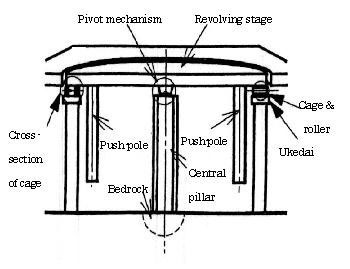 |
| Outline of the Konpira Theater revolving stage. |
 |
| Cage & roller set of the Konpira Theater revolving stage. |
 |
| This is a photo from underneath the stage at the Konpira Theatre. The stage was made to revolve with manpower using push poles located around the central pillar. Photographer: Christian Kaden |
 |
This is a photo of the stage at the Konpira Theatre.
If you look closely you can see the cutout of the revolving stage.
Photographer: Christian Kaden.
|
Thursday, 14 November 2013
Research Project: Dark Road
Dark Road Get-Out - Revolve stage
On 20th October, I was involved in the get out of DARK ROAD at the Lyceum Theatre in Edinburgh.
It was a set that was on a revolve and I was lucky to have been able to see the skeleton of the revolve. These are the images from during the get out.


This video on how a revolve is constructed by the company - The Revolving Stage Company - who provided this service to the Lyceum Theatre.
Finally, this link from the same company is interesting in that the technological advancement allows for the software to be sold to theatre or event companies to control up to eight revolving stages.
Subscribe to:
Posts (Atom)